
Category Archives: Language

CHINA LAYS CLAIM ON WORLD’S OLDEST CHINATOWN LOCATED IN THE PHILIPPINES

38f8c93f-0baf-4104-8ecb-1a266d3e5f91.Manila_Chinatown 004Beijing, China (The Adobo Chronicles) – Tensions continue to build in the South China Sea as China escalates both rhetoric and physical presence in the disputed territories in the Spratlys, a group of islands also claimed by the Philippines, Brunei, Malaysia, Taiwan and Vietnam.

The Spratly Islands are important for a number of reasons: the area holds potentially significant, but largely unexplored, reserves of oil and natural gas; it is a productive area for world fishing;  and it is one of the busiest areas of commercial shipping traffic.

News from various sources shows that China has not only started oil drilling operations in the area, but is also quietly attempting to build an artificial island, reclaiming parts of the sea to establish an aircraft runway.  Movements by Chinese supply ships have also been reported near at least two reefs in the disputed territories.

In yet another move by China to pursue what some world leaders are calling its “expansionist policy,” the Chinese government has formally filed papers before the United Nations claiming ownership of Manila’s Chinatown in the Binondo district, the oldest Chinatown in the world, established in 1594.

Sources close to the Beijing government told The Adobo Chronicles that if successful in its attempt to lay claim on Manila’s Chinatown, the Chinese government will build a wall around it and require passports and visas for non-Chinese citizens to dine or shop within what will be officially called Chinese Walled City.  The wall that will be built will mimic that of the Great Wall of China.

The government of Philippine President NoyNoy Aquino is still studying the matter and is not ready to issue a response or statement.

 

PHILIPPINES’ ENTRY TO OSCAR BEST ORIGINAL SONG CATEGORY REVEALED

The senator, the composer

Manila, Philippines (The Adobo Chronicles) – Filipino American music composer Robert Lopez may have started a possible winning streak for Filipinos in the much-coveted Oscar Award for Best Song, after winning in this year’s Academy Awards with his composition, ‘Let It Go,’ from the Disney movie Frozen.

The Philippines has yet to win an Oscar for Best Foreign Language Film, much less a nomination, but already, it has set its sight for the Best Original Song category, by submitting its official entry to the 2015 Oscars.

Although the song entry is not necessarily from a full-length film feature, the Philippines is hoping the American Academy of Motion Picture Arts and Sciences will bend its rules and consider a nomination for the Philippines’ extraordinary entry.

The song submission was composed by movie actor and Philippine Senator Bong Revilla, Jr., titled, “Salamat, Kaibigan”  (Thank you, friend). Revilla unveiled his composition during his privilege speech before the Philippine Senate, during which he proclaimed his innocence from charges of plunder in connection with the 10 Billion peso pork barrel scandal. He himself sang and recorded the song. He dedicated the song to all his supporters, believers and fans who continue to be on his side through thick and thin.

Revilla, along with other senators and congressmen, was among those indicted by the Philippine Ombudsman investigating the scam of siphoning taxpayer money into the pockets of politicians and businessmen. His arrest and detention may come any minute now.

Here is an exclusive video of the nominated song:


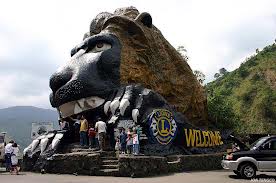
BAGUIO CITY IN THE PHILIPPINES TO BE RENAMED KOREA CITY

The famous Lion Sculpture that welcomes visitors to Baguio

Baguio City, Philippines (The Adobo Chronicles) – It is known as the summer capital of the Philippines because if its cool weather.  During the hot summer months, Filipinos trek to this mountain resort city by the hundreds of thousands to escape the sweltering temperatures in the lowland areas.  This is Baguio City, developed by the Americans in the early 1900’s, who found it to be an ideal site for a future city and summer retreat, especially for officers and employees of the Insular Government. It was designed for a population of 30,000 people, but today Baguio is home to 300,000, including over 20,000 South Koreans (and counting).

Many Koreans have found Baguio a suitable place to study English at local universities because of the relatively low cost of enrollment with no entrance exams required.  But more importantly, Baguio weather is comparable to the spring and autumn weather in their homeland. The Philippines’ Bureau of Immigration says that South Koreans come to Baguio on tourist visas and extensions thereof, student visas, and lately, to establish local businesses.

In recognition of the contribution of South Koreans to the city’s economy, tourism and overpopulation, the Baguio City Council has recently passed a resolution that would change the name of Baguio to Korea City.  Council members argued that Baguio has lost its allure anyway because of the local government’s failure to solve many of the city’s social, economic and environmental problems.  They believe that by adopting a new name, the city can bounce back and be the great city it once was. “This will attract even more Koreans to settle in the city, resulting in a unique cultural mix and creating a viable and progressive business climate,” said one council member.  He added that ‘Korea’ rhymes perfectly well with the name of the region Baguio belongs to — Cordillera.

Start practicing to say “Korea in the Cordillera.”