
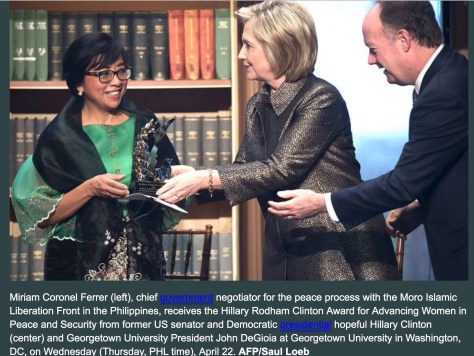
FILIPINA WINS HILLARY RODHAM CLINTON AWARD FOR TREASON

image WASHINGTON, D.C. (The Adobo Chronicles) – For the first time ever, a Filipina has won the Hillary Rodham Clinton Award for Advancing Women in Peace and Security in the person of Miriam Coronel Ferrer.

Ferrer is the goverment negotiator for the peace process with the Moro Islamic Liberation Front (MILF) in the Philippines.

The award was presented by  Clinton and Georgetown University President John DeGioia at Georgetown University in Washington D.C. on April 22.

The day after she received the award, Ferrer was charged with treason before the Office of the Ombudsman in Manila for conspiring in the approval of the controversial Bangsamoro Basic Law (BBL) which complainants described as ‘unconstitutional.’

Also included in the criminal complaints were President NoyNoy Aquino, Senate President Franklin Drilon, House Speaker Feliciano Belmonte, BBL government peace panel negotiator Teresita Deles as well  MILF representatives Murad Ebrahim, Mohagher Iqbal and Ghazali Jaafar.

In filing the complaint, former Assemblyman and Immigration Commissioner Homobono Adaza and government-critic Herman Tiu Laurel cited the respondents as co-conspirators in promoting the approval of the of the BBL, granting the MILF more power and territory beyond the limits set by the Constitution. They said the BBL violates at least 11 provisions of the Constitution on religion, equal protection rights and promoting social justice.
Among others, they said the accord would redefine Article 1 of the Constitution granting part of the national territory to the Bangsamoro and powers of sovereignty which are indivisible.

Upon learning of the charges, Clinton, who recently declared her candidacy for the Democratic presidential nomination in 2016, revised  Ferrer’s award to ‘Hillary Rodham Clinton Award for Advancing Women in Treason.’


SAN FRANCISCO BANS WIRE CLOTHES HANGERS

Photo credit: Bobby Calvan
Photo credit: Bobby Caina Calvan

SAN FRANCISCO, California (The Adobo Chronicles) – Last week, The Adobo Chronicles reported that the San Francisco Board of Supervisors unanimously approved a proposal to ban wild and exotic animals from circuses, parades, film and television.

Considered the most liberal and radical in the country, the SF Supes have approved uber measures like banning plastic bags in groceries and supermarkets and outlawing kids’ toys in McDonald’s Happy Meals.

On Friday, the Board unanimously approved to ban the use of wire clothes hangers in the city and county, a measure that San Francisco’s gay community has been clamoring for in the last couple of decades.

Supervisor Scott Wiener said that the “use of wire hangers is contrary to best fashion and grooming practices, what with all those ugly protruding ‘bumps’ on shirt and coat shoulders  resulting from wire hanging.”

In approving the measure, the Board also noted that the ban will also help reduce the number of car thefts, considering that wire hangers are a handy tool for thieves to pick car door locks.

The Human Rights Commision, the largest LGBT advocacy group in the country, immediately praised the new law and said it hopes that other cities and counties throughout the country will consider a similar proposal.


PHILIPPINES: GETTING MARRIED, BAPTIZED OR BURYING SOMEONE? MUST FIRST PLANT A TREE

imageILOILO, Philippines – Catholics who want to marry, have someone buried or baptized will soon be required to plant trees, according to a Memorandum of Agreement among the Catholic Church, the local government and the Department of Environmental and Natural Resources in the province of Iloilo  in Central Philippines.

Not just any kind of trees, but Bonsai trees.

‘Bonsai’ is a Japanese art form using miniature trees grown in containers. Similar practices exist in other cultures, including the Chinese tradition of penjing from which the art originated.

The agreement, signed on April 22 (Earth Day),  was originally aimed to reforest the lands denuded by Typhoon Yolanda (Haiyan) in 2013.  Thousands of trees, including century-old ones, were uprooted when Typhoon Yolanda hit the province.

However, many Catholics in the province — mostly from low-income families — complained that they do not own any land and would not be able to comply with the tree planting requirement.

As a compromise, the archbishop of Iloilo relaxed the requirement by allowing Catholics to instead plant Bonsai trees on pots and containers inside their homes or apartments.

Taking advantage of the new rule, SM Department Stores in the province quickly added Bonsai trees to their list of available items in their gift registries.

Couples getting married or parents having their children baptized in the Catholic Church can now request their invited guests to give them the gift of Bonsai.

For Catholic burials, families of the deceased can now add the following line in the obituaries:

‘In lieu of flowers, please consider bringing a Bonsai tree to the wake or funeral.’