
MISS WORLD CONFUSION: WILL THE REAL MISS PHILIPPINES PLEASE STEP FORWARD?

Miss Philippines, left, and Miss New Zealand, Filipinas both.

London, United Kingdom (The Adobo Chronicles) – The Philippines is known for champion boxers and beauty queens. Especially beauty queens. In 2013 alone, the country won three major international beauty pageant crowns : Miss World, Miss International, and Miss SupraNational. It also holds the 2013 crown for Miss Tourism International.

The Philippines is among the few elite countries (that includes Brazil and Venezuela) that have won the crown for all four major pageants — Miss World, Miss Universe, Miss International and Miss Earth.

In December, the 2014 Miss World Pageant will be held in London, during which the current title holder Megan Young of the Philippines, will crown her successor.  Will it be another Filipina?

There is a little problem within the Miss World Organization, however. Organizers seem to be confused about the Philippines’ candidate and the confusion extends to Germany and New Zealand.

Miss Philippines Valerie Weigmann, is half German while Miss New Zealand Arielle Diane Garciano, is half Filipino.  Weigmann’s father is  German while Garciano’s father is from Cebu in the Philippines.

Today,  the Philippines, Germany and New Zealand  filed a petition with the Miss World Organization asking that their respective candidates wear a red-colored sash to alert the judges and to make sure they are not confused about who is Miss Philippines, Miss Germany and Miss New Zealand.

In response, Miss World organizers said that during the evening gown and swimsuit competitions, the emcees will ask, “Will the real Miss Philippines please step forward?”

Surely, that would prevent any further confusion.

SCIENTISTS DISCOVER VIRUS THAT CAUSES STUPIDITY

imageNew York, New York (The Adobo Chronicles) –  U.S. scientists have identified a virus that attacks human DNA and causes stupidity in human beings. Those infected become less intelligent with the virus impairing brain activity, learning and memory.
Researchers from Johns Hopkins School of Medicine and the University of Nebraska have identified traces of an algae virus, known as ATCV-1, in throat swabs drawn from healthy volunteers which appeared to lessen their mental capacity.

The researchers, led by Dr. Robert Yolken, had originally been working on an unrelated study into throat microbes when they unexpectedly located traces of ATCV-1 in human DNA samples.

ATCV-1 typically infects a species of green algae found in lakes and rivers, and has not previously been known to infect humans.

According to the study, those infected with the virus performed around 10% worse on tests analyzing visual processing speeds, and were slower to draw a line connecting a sequence of numbers randomly distributed on a page than their uninfected counterparts. The researchers also found that the presence of the virus was linked to lower attention spans and decreased spatial awareness, and a “statistically significant decrease in the performance on cognitive assessments of visual processing and visual motor speed”.

The U.S. discovery seems to explain why politicians in the Philippines seem to be exhibiting extremely high levels of stupidity.  The presidential palace, Malacañang, sits on the banks of the Pasig river.  It is the official residence of President NoyNoy Aquino. It is also a frequent venue for meetings between the president and members of his Cabinet as well as of Congress.

The Pasig River is notoriously a polluted body of water constantly flowing with trash, debris and algae. No doubt, ATCV-1 lurks in the waters of the Pasig and has surely infected the occupants and frequent guests of the presidential palace.

It is time to clean up the palace and Congress, as well as the Pasig River.

AS BLUEFIN TUNA SUPPLY IS DEPLETED, SPAM SUSHI GAINS ENORMOUS POPULARITY

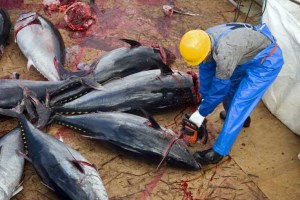
Bluefin tuna, an endangered species?

Tokyo, Japan (The Adobo Chronicles) –  There is some real bad news  for sushi lovers. Bluefin tuna, considered a delicacy in Japan and listed as endangered, has suffered a population decline of more than 96% in recent years, according to the National Oceanic and Atmospheric Administration. In addition, an estimated 90% of bluefin are caught before they can reproduce, crippling the species’ abilities to repopulate.

Bluefin tuna is one of the more popular of the sushi varieties.

But despair not.

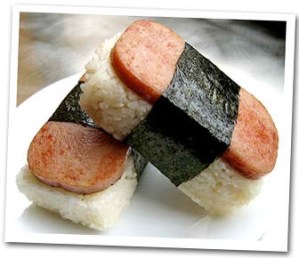
U.S.-based Hormel Foods has assured the sushi-consuming public that there is more than enough supply of SPAM, the main ingredient in SPAM sushi/musubi.

SPAM musubi is very popular in Hawaii and over the years, it has gained enormous following elsewhere in the U.S. as well as in Japan – thanks to ABC Stores (found in every street corner of Waikiki) that sell this delicacy to the delight of Japanese tourists that make up a huge percentage of Hawaii visitors.

SPAM Musubi
SPAM Musubi

Consumers who prefer the original tuna version of sushi will still find it in most sushi bars and Japanese restaurants worldwide, but for a hefty price, averaging  $265 per  small plate.

So, if SPAM is not your thing, and you can’t afford bluefin tuna sushi, we suggest you stick to California rolls. There should be ample supply of avocados everywhere.