MANILA, Philippines (The Adobo Chronicles) – Last year, the United States and the Philippines signed a 10-year defense agreement, considered by many as one of the clearest signs yet of renewed American engagement in the region at a time when tensions between China and its neighbors have been rising.
The agreement will entail moving American ships and planes to the Philippines more frequently as well as engaging in more training exercises with the country’s forces.
But a little-known provision in this pact is a firm commitment from the Americans to help the Philippines with the much-needed clean-up of the country’s environmental and political filth.
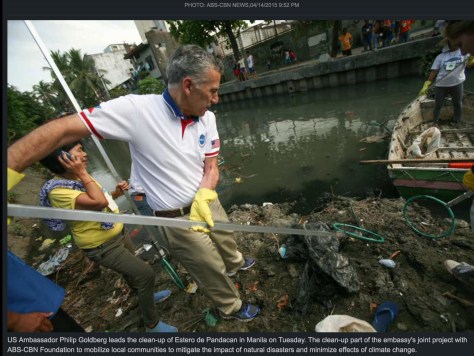
Today, U.S. Ambassador Philip Goldberg led hundreds of Filipino volunteers to undertake a massive clean-up of Manila’s Pasig River, known for many decades now for its polluted water and garbage-filled river banks. This dire situation has all but exacerbated the problem of perennial flooding in the metropolis.
Members of the international diplomatic corps also participated in today’s civic engagement project.
In talking to reporters after the day-long clean-up project, Goldberg said this was jut the beginning of many more projects schduled this year.
“Next, we will undertake a massive clean up of Philippine Congress, then Malacanang (the presidential palace), and finally the judiciary,” he said.
He was, of course, talking about political — not environmental — filth, including, but not limited to, the pork barrel scam, government curruption, the Aquino administration’s inefficiency, and justice for sale.
Malacañang Palace, official residence of the Philippine president
Manila, Philippines (The Adobo Chronicles) – The 2016 Philippine pr
esidential election is still twenty months away but already, Vice President Jejomar Binay is laying out plans for when he is elected the next president.
Binay continues to lead in the polls as the most likely to succeed President NoyNoy Aquino. By law, Aquino cannot seek reelection beyond his current six-year term. Unless, of course, he and his allies in Congress decide to amend the constitution.
Binay surprised reporters today when he said that if elected president, he is not going to reside in Malacañang, the Philippine presidential palace. Instead, he wants to continue living in the Coconut Palace.
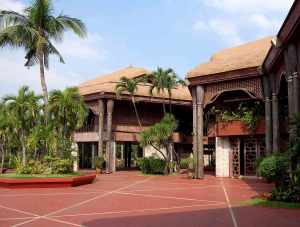
Also known as Tahanang Pilipino (Filipino Home), the Coconut Palace is a government
The Coconut Palace, official residence of the Philippine Vice President
mansion commissioned in 1978 by former First Lady Imelda Marcos as a guest house for visiting royalty and dignitaries. During his 1981 visit to the Philippines, Pope John Paul II refused to stay there because it was too opulent given the level of poverty in the Philippines. It cost 37 million Philippine pesos to build it.
In 2011, it became the official residence and principal workplace of the Philippine Vice President.
“My family and I enjoy living in the Coconut Palace,” Binay said, “because it is much more comfortable — being situated by the scenic Manila Bay, as opposed to the filthy Pasig River.” The rear facade of Malacañang sits on the banks of the river.
The Coconut palace is shaped like an octagon while its roof is shaped like a traditional Filipino salakot or hat. Some of its highlights are the 101 coconut-shell chandelier, and the dining table made of 40,000 tiny pieces of inlaid coconut shells. Highlighted as one of the Cultural Center of the Philippines’ most striking structures for its architecture and interiors, the palace celebrates the coconut as the ultimate “Tree of Life.” The palace’s design echoes all the elements of the coconut tree — from its roots and trunk to its bark, fruit, flower and shell.
The Coconut Palace has been a guesthouse for many guests, including Libyan leader Muammar al-Gaddafi, Brooke Shields and George Hamilton.
On the fifth season fifth season of the reality series The Amazing Race, the Coconut Palace served as the pit stop when the competing teams went to Manila.
Binay and his family are known for their passion for structures that cost tons of money. Binay and his son, Makati City Mayor Junjun, are the subject of controversy and investigation for the new, overpriced Makati City Hall which began construction when the older Binay was mayor of Makati.
According to complaints, the Makati City government allocated P2.7 billion for the construction of the project when it only declared P1.5 billion as the total cost of the project.
Binay said that being near Manila Bay would make it easier for me to flee the country in the event of another People’s Revolution, referring to the citizen movement that drove Ferdinand Marcos out of power and into exile. The Coconut Palace is located relatively close to the U.S. Embassy in Manila and that certainly accounts for something.
Manila, Philippines – Metro Manila in the Philippines is probably the most congested metropolis in the entire world. It comprises of several big cities and towns with their respective local government units but that in itself makes the delivery of government services truly inefficient and ineffective. That is about to end.
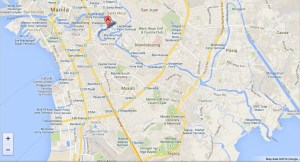
Manila Mayor and former Philippine President Joseph Estrada is proposing to split Metro Manila into just two major cities: Northern Manila and Southern Manila. Estrada’s plan is quite simple. The division line will be the Pasig River which runs from Manila Bay to Laguna Bay. All cities and towns north of the Pasig River will comprise Northern Manila and everything else south of the river will comprise Southern Manila.
There is one big problem.
Most of Manila and Makati are south of the Pasig River, which begs the question, who will be the mayor of Southern Manila? Joseph Estrada or Makati Mayor Junjun Binay, son of incumbent Vice President Jejomar “Jojo” Binay who is running for president in 2016?
A poll conducted by The Adobo Chronicles shows a 50-50 split in support for Estrada and Binay.

 MANILA, Philippines (The Adobo Chronicles) – Last year, the United States and the Philippines signed a 10-year defense agreement, considered by many as one of the clearest signs yet of renewed American engagement in the region at a time when tensions between China and its neighbors have been rising.
 Binay and his family are known for their passion for structures that cost tons of money. Binay and his son, Makati City Mayor Junjun, are the subject of controversy and investigation for the new, overpriced Makati City Hall which began construction when the older Binay was mayor of Makati.
 Manila, Philippines – Metro Manila in the Philippines is probably the most congested metropolis in the entire world. It comprises of several big cities and towns with their respective local government units but that in itself makes the delivery of government services truly inefficient and ineffective. That is about to end.
 The Adobo Chronicles
You must be logged in to post a comment.