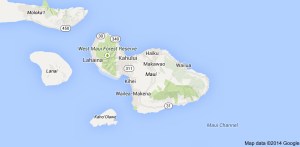
Maui, Hawaii (The Adobo Chronicles) – The islands of Maui are slowly but surely falling into the hands of tech billionaires like Oracle’s Larry Ellison and Facebook’s Mark Zuckerberg.
Ellison, who recently stepped down as chairman of Oracle Corporatiom, had previously bought the entire island of Lāna’i and has started to build his dream retirement home in what he plans to rename Ellis Island of the Pacific.
Now, The Adobo Chronicles has confirmed that Zuckerberg has closed escrow on the island of Moloka’i. The 30-year old Facebook founder and CEO has no plans for retirement at the moment but he has already laid out elaborate plans to build a Facebook Fantasy Island that is sure to relegate Disneyland into a mere “small world.”
Zuckerberg’s plans were revealed just as he made headlines in San Francisco after his neighbors complained about the ongoing construction of his home in the city. It has been reported that Zuckerberg has bought four other properties surrounding his home and has spent the last year and a half developing his expanded residential compound. Neighbors have complained that they could not even park their cars in front of their homes because of road blocks and heavy equipment parked in the area.
With Ellison and Zuckerberg now owning the two islands in Maui, residents of nearby Kaua’ i have expressed concern that their garden island, too, will soon be owned by another tech billionaire. Who could it be?
We’re guessing Apple’s Tim Cook. And we predict that he will rename Kauai the ‘Little Apple of the Pacific.’
San Francisco, California (The Adobo Chronicles) – The Asian American Journalists Association (AAJA), a national membership organization composed of Asian Americans working in mainstream media, has sent a strongly-worded letter to the Hawaii Tourism Authority (HTA) demanding that the name ‘Chinaman’ be erased from all literature and references to Chinaman’s Hat, a famed attraction on the island of Oahu.
Located in Kāne’ohe Bay, Chinaman’s Hat, also known as Mokoli’i Island, is a scenic wonder resembling that of a cone-shaped straw hat often seen worn in several countries in Southeast Asia.
But the term ‘Chinaman’ is considered derogatory, according to AAJA and other Asian American groups. MediaWatch, AAJA’s watchdog arm, has been calling out news organizations that have printed or broadcast terms, phrases or statements that are considered racist, discriminatory or offensive to the Asian American community in the U.S.
In its stylebook distributed to newsrooms, AAJA has this to say about the term:
The Adobo Chronicles learned that HTC has yet to receive the letter which was supposedly sent by registered mail from AAJA’s headquarters in San Francisco. Nevertheless, HTC questioned why it has taken this long for AAJA to demand this change, when Chinaman’s Hat has been the name of this tourist attraction for many decades, perhaps even predating the journalist organization.
“Besides,” HTC said, “it will cost the state tourism body millions of dollars to make the change, having to update all tourism videos, brochures, and web sites, not to mention the cost of re-educating both Hawaii residents and tourists about a new name.”
What could that new name be? Perhaps, the island could be renamed after Hawaii’s state fish, humuhumunukunukuapua’a ? That would seem appropriate.
Malacañang Palace, official residence of the Philippine president
Manila, Philippines (The Adobo Chronicles) – The 2016 Philippine pr
esidential election is still twenty months away but already, Vice President Jejomar Binay is laying out plans for when he is elected the next president.
Binay continues to lead in the polls as the most likely to succeed President NoyNoy Aquino. By law, Aquino cannot seek reelection beyond his current six-year term. Unless, of course, he and his allies in Congress decide to amend the constitution.
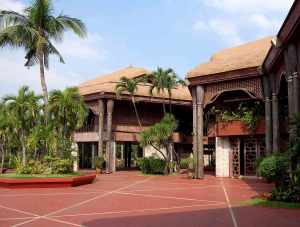
Binay surprised reporters today when he said that if elected president, he is not going to reside in Malacañang, the Philippine presidential palace. Instead, he wants to continue living in the Coconut Palace.
Also known as Tahanang Pilipino (Filipino Home), the Coconut Palace is a government
The Coconut Palace, official residence of the Philippine Vice President
mansion commissioned in 1978 by former First Lady Imelda Marcos as a guest house for visiting royalty and dignitaries. During his 1981 visit to the Philippines, Pope John Paul II refused to stay there because it was too opulent given the level of poverty in the Philippines. It cost 37 million Philippine pesos to build it.
In 2011, it became the official residence and principal workplace of the Philippine Vice President.
“My family and I enjoy living in the Coconut Palace,” Binay said, “because it is much more comfortable — being situated by the scenic Manila Bay, as opposed to the filthy Pasig River.” The rear facade of Malacañang sits on the banks of the river.
The Coconut palace is shaped like an octagon while its roof is shaped like a traditional Filipino salakot or hat. Some of its highlights are the 101 coconut-shell chandelier, and the dining table made of 40,000 tiny pieces of inlaid coconut shells. Highlighted as one of the Cultural Center of the Philippines’ most striking structures for its architecture and interiors, the palace celebrates the coconut as the ultimate “Tree of Life.” The palace’s design echoes all the elements of the coconut tree — from its roots and trunk to its bark, fruit, flower and shell.
The Coconut Palace has been a guesthouse for many guests, including Libyan leader Muammar al-Gaddafi, Brooke Shields and George Hamilton.
On the fifth season fifth season of the reality series The Amazing Race, the Coconut Palace served as the pit stop when the competing teams went to Manila.
Binay and his family are known for their passion for structures that cost tons of money. Binay and his son, Makati City Mayor Junjun, are the subject of controversy and investigation for the new, overpriced Makati City Hall which began construction when the older Binay was mayor of Makati.
According to complaints, the Makati City government allocated P2.7 billion for the construction of the project when it only declared P1.5 billion as the total cost of the project.
Binay said that being near Manila Bay would make it easier for me to flee the country in the event of another People’s Revolution, referring to the citizen movement that drove Ferdinand Marcos out of power and into exile. The Coconut Palace is located relatively close to the U.S. Embassy in Manila and that certainly accounts for something.




 Binay and his family are known for their passion for structures that cost tons of money. Binay and his son, Makati City Mayor Junjun, are the subject of controversy and investigation for the new, overpriced Makati City Hall which began construction when the older Binay was mayor of Makati.
 The Adobo Chronicles
You must be logged in to post a comment.