Tag Archives: Chinese New Year

How Year Of The Monkey Can Make Senator Grace Poe The Next President Of The Philippines

imageMANILA, Philippines (The Adobo Chronicles) – February 8 marks the Chinese New Year in the Philippines, where it is a national holiday.  It ushers in the Year of the Monkey.

Of the five major Philippine presidential candidates, one — Senator Grace Poe — was born in the Year of the Monkey (1968). Specifically, Poe is an Earth monkey whose qualities include being frank, optimistic and fearless — all great qualities for a Filipino head of state.

But alas, the year 2016 — the year of the presidential elections — is believed by many to be an unlucky year for people born in a Monkey year like Poe.

But there are things that Poe and her campaign can do to turn the year from unlucky to lucky, according to Chinese zodiac experts:

1. Poe must always wear red.  Luckily for her, she is not running under the banner of the Yellow Party.  She may have already aborted a misfortune by declining President Aquino’s Liberal Party’s invitation for her to be the vice presidential running mate of former Interior Secretary Mar Roxas.  Red is one of the lucky colors for people born in a Monkey year.

2. Poe must always wear jade. We have seen her wear pearl jewelry and accessories on many occasions.  She must now set aside all her pearl and other jewelry in favor of jade pendants, earrings, rings and bracelets. Jade is known to ward off bad luck.

3. Poe must constantly face in the opposite direction that is dictated by Tai Sui. Tai Sui (Chinese: 太歲; pinyin: Tàisuì) refers to stars directly opposite to Jupiter. They influence the Chinese zodiac, and are involved in religious Taoism and Feng Shui. For those born in Monkey years, facing Southwest can bring them bad luck.  So Poe must face in the Northeast direction which happens to be close to where Malacañang Palace is.

So there you go, Madam Senator:  three simple rules to follow that could lead you on the path to Malacañang.

Already, Poe has regained the top spot among presidential contenders, based on the results of the latest survey conducted by Pulse Asia Research, Incorporated released on Saturday, February 6. A good omen?

To all our readers, Gung Hay Fat Choy!  Happy New Year!

 

MEDIA GUIDE TO 2015 LUNAR NEW YEAR

imageSAN JOSE, California (The Adobo Chronicles) – Is it the Year of the Sheep, Goat or Ram?

If you’re confused about what to call the 2015 Lunar New Year, don’t fret.  We are as confused as you are.

As a public service, The Adobo Chronicles has issued a media advisory to guide editors, reporters and netizens in properly making reference to the new year:

CHINESE NEW YEAR (Wrong) – It is not only the Chinese that celebrate the New Year. So do many other countries and cultures that subscribe to the Lunar calendar, like Vietnam, Laos, Cambodia, Mongolia, Tibet, Korea, Japan, Myanmar, Thailand, and … well you know what we mean. The politically-correct term is LUNAR NEW YEAR.

YEAR OF THE SHEEP (Use with caution) – Sheep is the female Ram.  Be careful when using ‘Year of the Sheep’ as it may be offensive to the male population in the countries celebrating the Lunar New Year.

YEAR OF THE RAM (Use with caution) – Ram is the male Sheep. Be careful when using ‘Year of the Ram’ as it may be offensive to the female population in the countries celebrating the Lunar New Year.

YEAR OF THE GOAT (Be mindful when using) – Many people favor the sheep over the goat because the sheep looks better in pictures (and selfies), especially with its  white, thick coat. But also remember that sheep may not be found in many tropical countries, except perhaps for farm breeding. But they have goat, so ‘Year of the Goat’ may be more appropriate. Incidentally, have you tasted goat meat? They’re delicious! When in the Philippines, try the kalderetang kambing, kilaweng kambing or adobong kambing . When in Baguio City, Philippines, the best place to go for goat meat is the Slaughter House.

GUNG HAY FAT CHOY (Spelling doesn’t matter) – It doesn’t matter how you spell this traditional ‘Happy New Year’ greeting, as long as it sounds the same or similar. ‘Kung Hei Fat Choi,’ Gung Hay Fat Choi,’ Gong Hei Fat Choy, ‘Gong Xi Fa Cai.’ To be safe, when greeting someone a Lunar Happy New Year, just make a phone call.  Don’t embarrass yourself by posting on your Facebook Page or Twitter Account.

To one and all, HAPPY NEW YEAR! Lunar New Year, that is.

PRESIDENT AQUINO DECLARES 2015 AS YEAR OF THE CARABAO

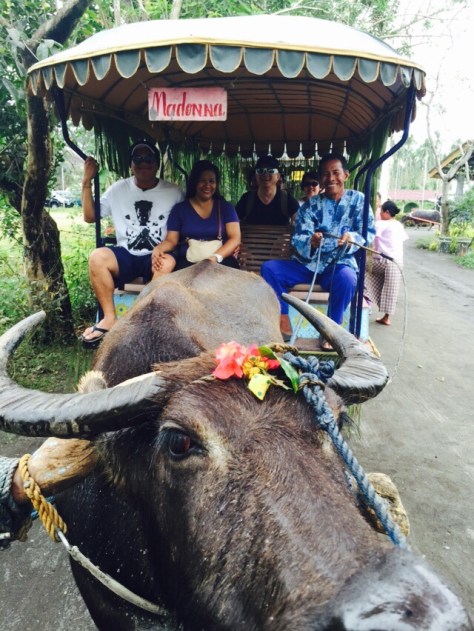
 Madonna, the hard-working Carabao of Villa Escudero in the Philippines (Photo: The Adobo Chronicles)
Madonna, the hard-working Carabao of Villa Escudero in the Philippines (Photo: The Adobo Chronicles)

MANILA, Philippines (The Adobo Chronicles) – It was a non-working holiday last February 19 in the Philippines, as declared by President NoyNoy Aquino, to observe the Lunar New Year.

Elsewhere in the world, an entire year has been lost in translation, with countries and communities celebrating the Year of the Goat, Year of the Ram, Year of the Sheep. So  which is it?

What is little known about Aquino’s holiday proclamation was that his staff at the presidential palace, Malacanang, were very confused as to what to call this Lunar New Year. In doing some research, the staff determined that Yang (the sign for this New Year) is loosely translated as a “horned animal,” hence the confusion among the goat, ram and sheep — all horned animals.

To clear the confusion, Aquino, in his actual proclamation, decided that this year is the Year of the Carabao in the Philippines.  The carabao (water buffalo) is a horned animal that is used in many farm lands in the country.

Designating this as the Year of the Carabao makes it more appropriate and significant to the Philippine setting, Aquino said, since there are no sheep or rams in the country — only goats.

Kilawen na Kambing, a Filipino dish akin to ceviche, but made from goat meat. (Photo: The Adobo Chronicles)

Despite the year being designated as the Year of the Carabao, residents of Baguio City, the country’s summer capital, celebrated the holiday by having family feasts consisting of kalderetang kambing, adobong kambing and kilawen na kaming, all goat delicacies popular among folks in Baguio and other parts of the country.