

Category Archives: real estate

A Flawed Study On Baguio’s One And Only “Livable” Barangay

A recent study, promoted by Rappler, has unveiled that in Baguio City, the “summer capital” of the Philippines, only one of its 128 barangays is deemed livable. The sole gem in this mountain metropolis? South Drive.

One can almost hear the laughter echoing through the pine trees, as South Drive, with its population of less than 600, is akin to a millionaire’s row. Flanked by posh hotels like The Manor and the sprawling greens of Camp John Hay, this barangay offers condos at a paltry P13 million and house-and-lots for a modest P68 million.

It seems that “livable” in this context equates to owning a luxury vehicle to brave Baguio’s notorious traffic en route to the public market or central district. One wonders if “livable” also includes dealing with the inefficiencies of BENECO and the Baguio Water District, the city’s beloved utility providers.

Perhaps the study’s authors were dazzled by the sheer opulence of South Drive, mistaking it for a utopia amidst the urban jungle.

Instead of titling the study “livable,” a more fitting moniker would be “the most affluent barangay.” After all, in the grand narrative of urban living, where traffic snarls and utility woes are the great equalizers, South Drive’s affluence seems to be the only distinguishing factor.
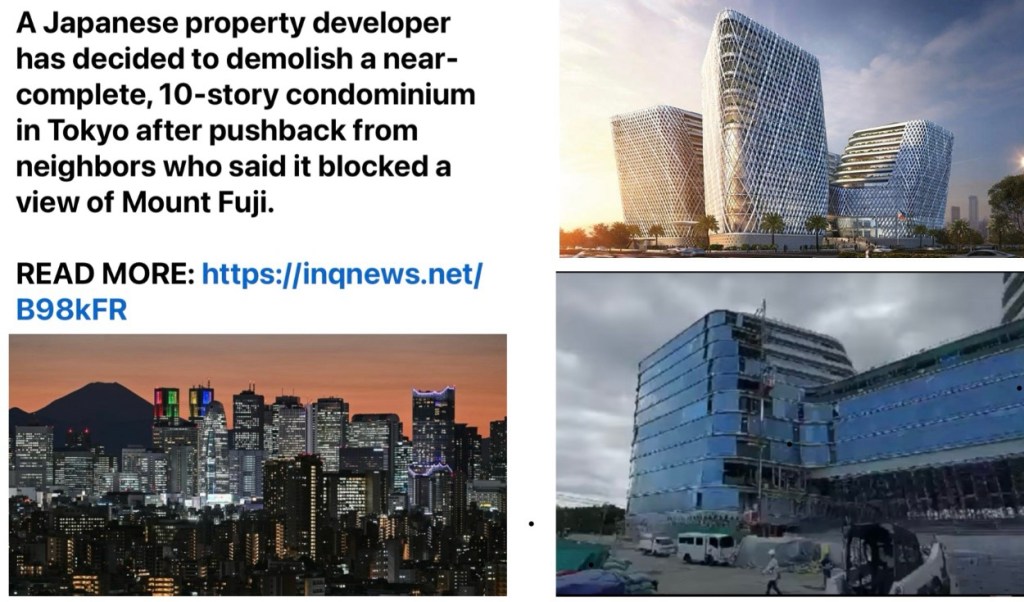
Convert New Senate Building To Affordable Housing?

In a bold display of prioritizing aesthetics over infrastructure, Japanese builders have decided to demolish an almost-finished high-rise building. The reason? It dared to obstruct the sacred view of Mount Fuji. Clearly, the panorama of a majestic peak was worth more than the millions invested in steel and concrete.

Meanwhile, across the waters in the Philippines, the new Senate Building’s construction budget has undergone a miraculous expansion—from a modest P8.9 million to a staggering P23.3 million. One can only marvel at how democracy has gotten so pricey.

Rather than demanding its demolition, perhaps Filipinos should repurpose this golden monument to political excess. Turning it into low-cost apartments might just offer a roof to those perpetually priced out of the housing market.

After all, who needs a Senate when you can have affordable housing?

Perhaps the Filipinos can teach the Japanese a thing or two about functional repurposing.

Trends: Japan’s See-Through Toilets, Philippines’ Outdoor Curtains And Split Air-conditioners.

In the ever-evolving world of real estate trends, the absurd has become the new normal. Japan, always at the forefront of innovation, has unveiled transparent public restrooms, ensuring that the world knows when nature calls. Nothing says “vacant and clean” like a see-through toilet bowl.

Meanwhile, in the Philippines, condominium living has taken a voyeuristic turn with the introduction of outdoor curtains. It provides better sun block while encouraging passers-by to indulge in some neighborly gossip.

But wait, there’s more! Outdoor split air-conditioning units are the pièce de résistance, delivering a breath of cool air while residents soak up their daily dose of Vitamin D. 

In the world of real estate, it seems the only limit is the extent of one’s imagination—or lack thereof.

(Melchor Vergara contributed to this report.)